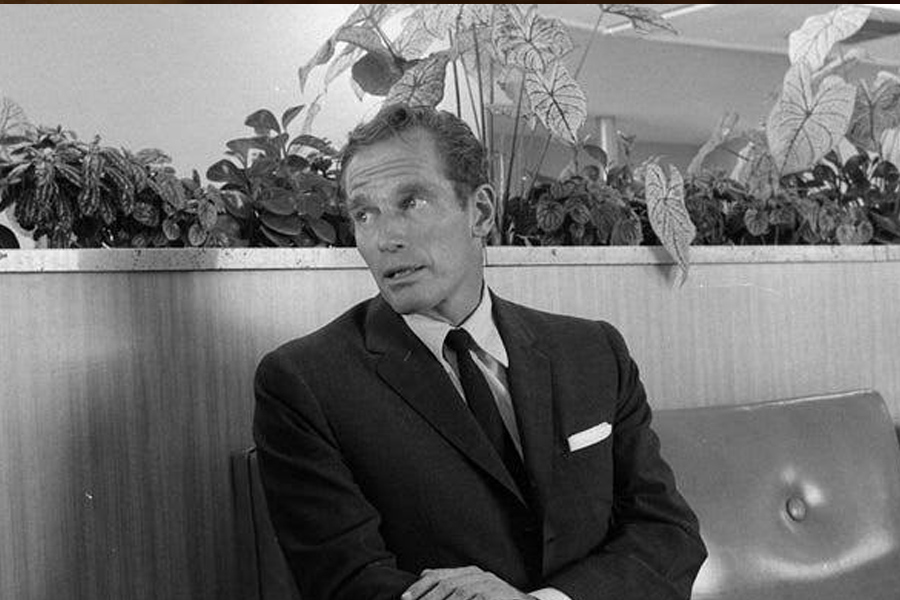
Basic Information
| Field | Details |
|---|---|
| Full Name | John Charles Carter |
| Stage Name | Charleston Heston |
| Date of Birth | October 4, 1923 |
| Birthplace | Evanston, Illinois, USA |
| Height | 6 feet 3 inches |
| Occupation | Actor, Director, Political Activist |
| Years Active | 1941 to 2003 |
| Spouse | Lydia Clarke |
| Children | Fraser Clarke Heston, Holly Ann Heston |
| Date of Death | April 5, 2008 |
| Age at Death | 84 |
Early Life and Formative Years
At his roots, Charleston Heston was shaped by calm forests and small town rhythms. John Charles Carter, born in Illinois in 1923, spent his childhood in Michigan, where life was plain and solitary. Fishing, long walks, and a one-room schoolhouse shaped his childhood. It was a blank canvas for imagination to flourish.
He found his parents’ divorce as a child unpleasant. It was like a permanent break in glass. His mother remarried Chet Heston, and the name became famous in film. Charleston Heston was a strong name he created by combining his stepfather’s surname and his mother’s maiden name.
Education, War, and the Path to Acting
I often think of his college years as the bridge between obscurity and destiny. At Northwestern University, he discovered not only acting but also partnership. It was there he met Lydia Clarke, the woman who would become his lifelong companion.
World War II interrupted everything. He served in the U.S. Army Air Forces as a radio operator and gunner in the Pacific theater. War sharpened him. It gave him discipline and a sense of scale, qualities that later appeared in every commanding role he played.
After the war, he stepped into New York with ambition in his pocket. Broadway became his training ground. His debut in Antony and Cleopatra in 1947 marked the beginning of a long climb. Television followed, then film. Each role added another layer to his presence.
Rise to Stardom in Epic Cinema
When I think of Charleston Heston on screen, I see a figure larger than life. His breakthrough came in the 1950s, a decade that turned him into a cinematic monument.
In 1956, he became Moses in The Ten Commandments. That role alone could define a career. Yet he went further. In 1959, he played Judah Ben Hur in Ben Hur, a performance that earned him the Academy Award for Best Actor. The film itself collected 11 Oscars, a towering achievement.
He moved through history and imagination with ease. El Cid in 1961 showed him as a medieval hero. Planet of the Apes in 1968 revealed his strength in science fiction. Soylent Green in 1973 added a darker edge. Each role felt like a chapter carved into stone tablets.
His voice carried authority. His posture spoke before he did. He was not just acting. He was inhabiting myth.
A Life in Theater, Television, and Direction
While film brought fame, his connection to theater never faded. I see him returning to Shakespeare again and again, like a craftsman revisiting his favorite tool. He even directed Antony and Cleopatra in 1972, proving his creative reach extended beyond acting.
Television and narration added further depth to his career. His voice became instantly recognizable. It could command silence or stir emotion with equal ease.
His career lasted over six decades, from 1941 to 2003. Few actors sustain that kind of longevity. It speaks to both discipline and adaptability.
Family and Personal Bonds
His life revolved around Lydia Clarke. Their 1944 marriage lasted 64 years. Their love gave them stability in renown. Art and family were balanced in their existence.
Fraser Clarke Heston, their son, was imaginative. A 1955-born filmmaker, director, and writer. He played baby Moses in The Ten Commandments, a small but symbolic debut. After working with his father, he directed films like Needful Things. He fathered Jack Heston, continuing the line.
Their 1961-born daughter Holly Ann Heston chose privacy. She prioritized family and charity. After marrying Carlton Charles Rochell Jr., she lived for purpose rather than fame. Her children, Ridley Charlton Rochell and Charlie Rochell, continued the Heston heritage.
I view him as a public figure who enjoyed shared meals, outdoor experiences, and quiet laughter. He was friendly, principled, and funny in unexpected ways, according to his relatives.
Political Voice and Public Influence
Charleston Heston’s political journey was as dramatic as his film roles. In the 1950s and 1960s, he stood firmly in support of civil rights. He marched alongside Martin Luther King Jr. in 1963, placing himself on the right side of history during a pivotal moment.
Later, his views shifted. By the 1980s, he aligned with conservative ideals, emphasizing individual liberty and constitutional rights. His role as president of the National Rifle Association from 1998 to 2003 brought him into the national spotlight once again.
His speeches carried the same intensity as his performances. He spoke with conviction, framing his beliefs as a defense of fundamental freedoms. Whether praised or criticized, he remained consistent in his willingness to speak out.
Leadership in the Screen Actors Guild
From 1965 to 1971, he served as president of the Screen Actors Guild. I see this period as one of steady leadership. He focused on practical improvements, negotiating better benefits, pensions, and protections for actors during a time of industry change.
His presence brought visibility to the organization. He was not just a figurehead. He participated directly in discussions and decisions, helping guide the guild through a transformative era.
Later Years and Final Chapter
He reported Alzheimer’s symptoms in 2002. He began withdrawing from public life. For a film and political giant, this peaceful hideaway felt human.
He died at 84 in Beverly Hills on April 5, 2008. The immediate cause was pneumonia. His wife accompanied him. His ashes were returned to his family, his loved ones.
Success was evident in his Beverly Hills home and estate. With an estimated $40 million net worth, his legacy went beyond art.
Achievements and Recognition
His career brought numerous honors. The Academy Award for Best Actor marked a peak, but it was not the only recognition. He received the Golden Globe Cecil B. DeMille Award, the Screen Actors Guild Life Achievement Award, and the Kennedy Center Honors in 1997.
In 2003, he was awarded the Presidential Medal of Freedom. Each honor felt like a milestone on a long road of dedication.
FAQ
Who was Charleston Heston?
Charleston Heston was an American actor and political activist known for his roles in epic films such as Ben Hur and The Ten Commandments, as well as his influential public presence.
What was his birth name?
His birth name was John Charles Carter, which he later changed to Charleston Heston for his acting career.
Who was his spouse?
He was married to actress Lydia Clarke for 64 years, from 1944 until his death in 2008.
How many children did he have?
He had two children, Fraser Clarke Heston and Holly Ann Heston, both of whom maintained strong ties to his legacy.
What were his most famous films?
His most notable films include Ben Hur, The Ten Commandments, El Cid, Planet of the Apes, and Soylent Green.
What was his role in politics?
He began as a civil rights supporter and later became a prominent conservative voice, serving as president of the National Rifle Association.
When did he pass away?
He passed away on April 5, 2008, at the age of 84.
What awards did he receive?
He received numerous honors, including an Academy Award, a Golden Globe, a Screen Actors Guild Life Achievement Award, and the Presidential Medal of Freedom.